


Page 16 - Quick
P. 16
Informazioni tecniche

           Technical informations


                                            Informazioni utili per interpretare i dati illuminotecnici dei vari prodotti.
                                            Useful information to understand the lighting data of the different products.
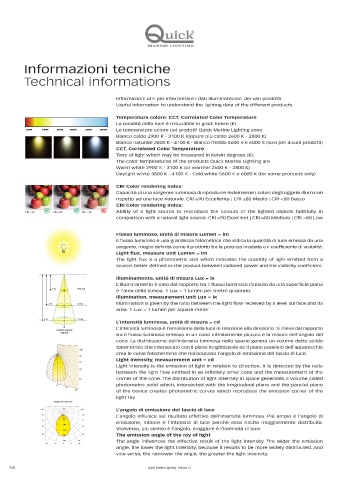
                                            Temperatura colore: CCT, Correlated Color Temperature
                                            La tonalità della luce è misurabile in gradi Kelvin (K).
                                            Le temperature colore dei prodotti Quick Marine Lighting sono
                                            Bianco caldo 2900 K - 3100 K (oppure più caldo 2600 K - 2800 K)
                                            Bianco naturale 3800 K - 4100 K - Bianco freddo 5600 K e 6000 K (solo per alcuni prodotti)
                                            CCT, Correlated Color Temperature
                                            Tone of light which may be measured in Kelvin degrees (K).
                                            The color temperatures of the products Quick Marine Lighting are
                                            Warm white 2900 K - 3100 K (or warmer 2600 K - 2800 K)
                                            Daylight white 3800 K - 4100 K - Cold white 5600 K e 6000 K (for some products only)
                                            CRI Color rendering Index:
                                            Capacità di una sorgente luminosa di riprodurre fedelmente i colori degli oggetti illuminati
                                            rispetto ad una luce naturale. CRI ≥90 Eccellente | CRI ≥80 Medio | CRI <80 Basso
                                            CRI Color rendering Index:
            CRI > 90  CRI ≥ 80  CRI  < 80   Ability of a light source to reproduce the colours of the lighted objects faithfully in
                                            comparison with a natural light source. CRI ≥90 Excellent | CRI ≥80 Medium | CRI <80 Low


                                            Flusso luminoso, unità di misura Lumen = lm
                                            Il flusso luminoso è una grandezza fotometrica che indica la quantità di luce emessa da una
                                            sorgente, meglio definita come il prodotto tra la potenza irradiata e il coefficiente di visibilità.
                                            Light flux, measure unit Lumen = lm
                                            The light flux is a photometric size which indicates the quantity of light emitted from a
                                            source, better defined as the product between radiated power and the visibility coefficient.

                                            Illuminamento, unità di misura Lux = lx
                                            L’illuminamento è dato dal rapporto tra il flusso luminoso ricevuto da una superficie piana
                     1 m      100 lux
                                            e l’area della stessa. 1 Lux = 1 lumen per metro quadrato.
                                            Illumination, measurement unit Lux = lx
                                            Illumination is given by the ratio between the light flow received by a level surface and its
                    2 m       25 lux
                                            area. 1 Lux = 1 lumen per square meter
                  3 m         11 lux
                                            L’intensità luminosa, unità di misura = cd
                                            L’intensità luminosa è l’emissione della luce in relazione alla direzione. Si rileva dal rapporto
                       Luminous Intensity
                   Angolo del Fascio 90°
                        100 cd
                                            tra il flusso luminoso emesso in un cono infinitamente piccolo e la misura dell’angolo del
                                            cono. La distribuzione dell’intensità luminosa nello spazio genera un volume detto solido
                                            fotometrico che intersecato con il piano longitidunale ed il piano parallelo dell’apparecchio
                               105°
                                            crea le curve fotometriche che riproducono l’angolo di emissione del fascio di luce.
                               90°
                                            Light intensity, measurement unit = cd
                               75°
                                            Light intensity is the emission of light in relation to direction. It is detected by the ratio
                               60°
                                            between the light flow emitted in an infinitely small cone and the measurement of the
                                            corner of the cone. The distribution of light intensity in space generates a volume called
                               45°
                       0°                   photometric solid which, intersected with the longitudinal plane and the parallel plane
                          15°
                                            of the device creates photometric curves which reproduce the emission corner of the
                             30°
                                            light ray.
                      Angolo del Fascio 80°
                 105     50    105          L’angolo di emissione del fascio di luce
                                            L’angolo influisce sul risultato effettivo dell’intensità luminosa. Più ampio è l’angolo di
                 90             90
                         50
                 75             75
                                            emissione, minore è l’intensità di luce perchè essa risulta maggiormente distribuita.
                         100
                 60             60
                         150                Viceversa, più stretto è l’angolo, maggiore è l’intensità di luce.
                 45             45          The emission angle of the ray of light
                         200
                         250  cd            The angle influences the effective result of the light intensity. The wider the emission
                   30  15  0  15  30
                                            angle, the lower the light intensity, because it results to be more widely distributed. And
                  NEW CRISTIAN 7W
                  luce calda
                                            vice-versa, the narrower the angle, the greater the light intensity.
      16                                               Quick Marine Lighting - Edition 12

